


Inspired by Frank Lloyd Wright’s Philosophy of ‘Organic Architecture‘
Frank Lloyd Wright’s philosophy of Organic Architecture urges us to “Study nature, love nature, stay close to nature.” In this exhibition, our students have fully embraced this ethos, not simply replicating the natural world, but distilling its essence through the lens of geometry. The result is a collection of works that exist in a space where organic forms and rigid abstraction converge, inviting the viewer to engage in a more nuanced and contemplative experience.
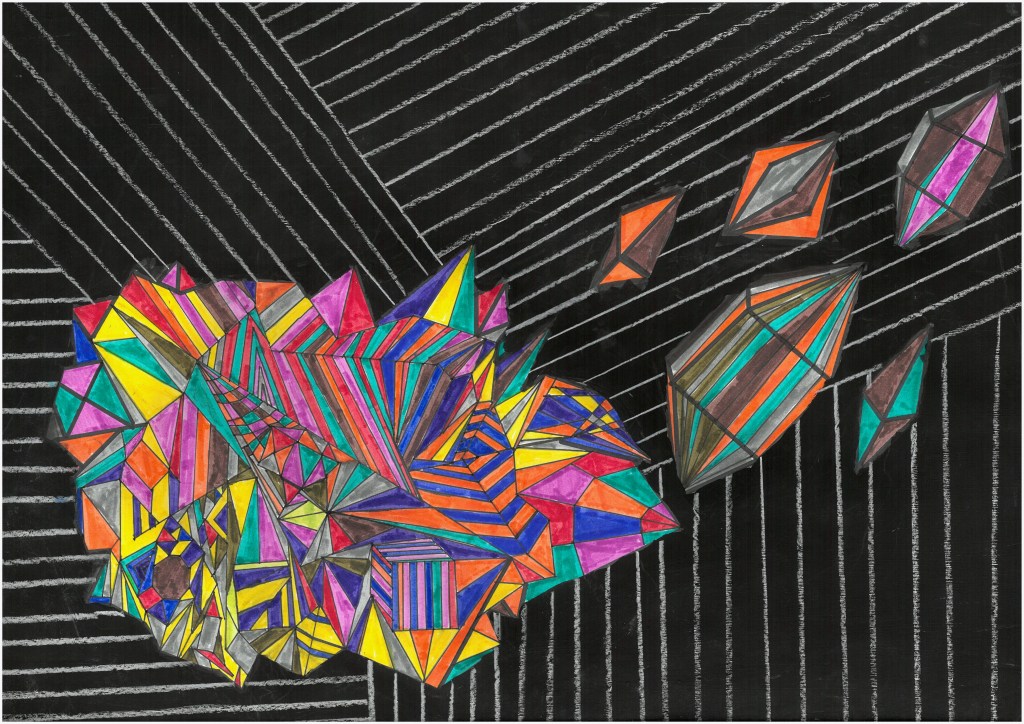
As you explore this visual landscape, you will encounter sharp contrasts—bold geometries and vibrant color schemes that still manage to evoke the underlying softness of natural forms. In one composition, sharp crystalline forms, fractured into angular prisms, emerge from a stark black background, creating a dynamic tension between control and chaos. The interplay of vivid colors, ranging from electric oranges to deep purples, suggests an explosion of energy radiating outward, as if nature is reassembling itself into something both recognizable and otherworldly.
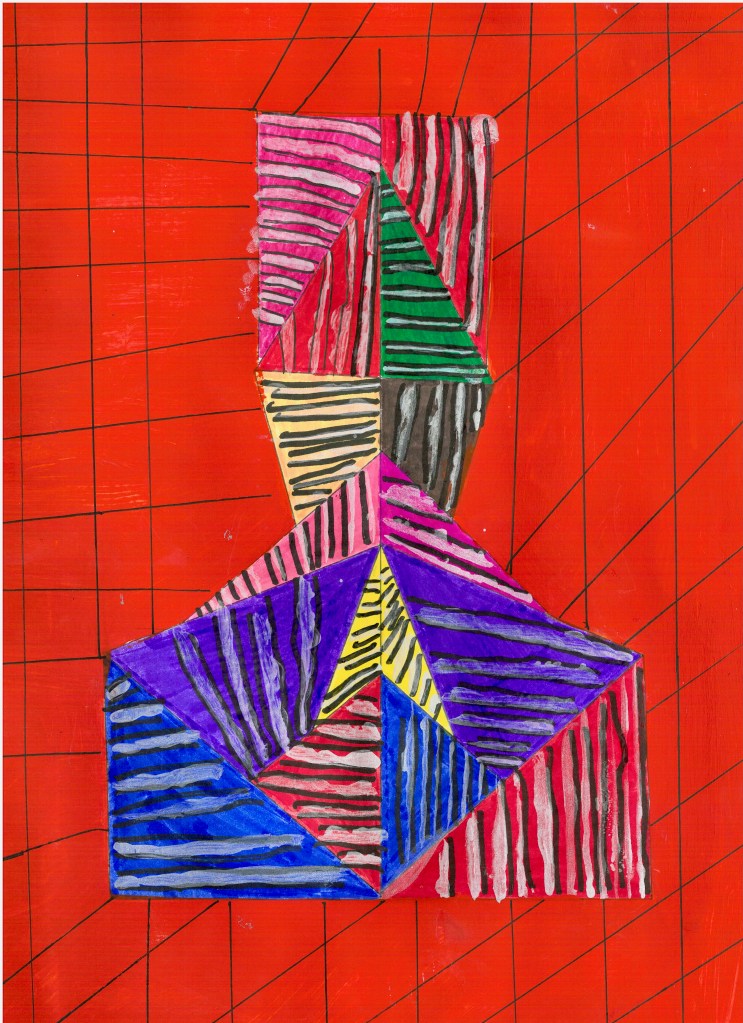
Another work presents a single flower, reduced to its essential geometry, commanding the viewer’s attention. The concentric layers of red and orange petals create a rhythmic, ordered form, contrasting with the clean, parallel lines of the background that seem to stretch infinitely. The angular repetition in the background juxtaposes the organic stem and petals, yet both elements find harmony in their shared precision, offering a reminder of the inherent structure present in nature’s seemingly chaotic forms.
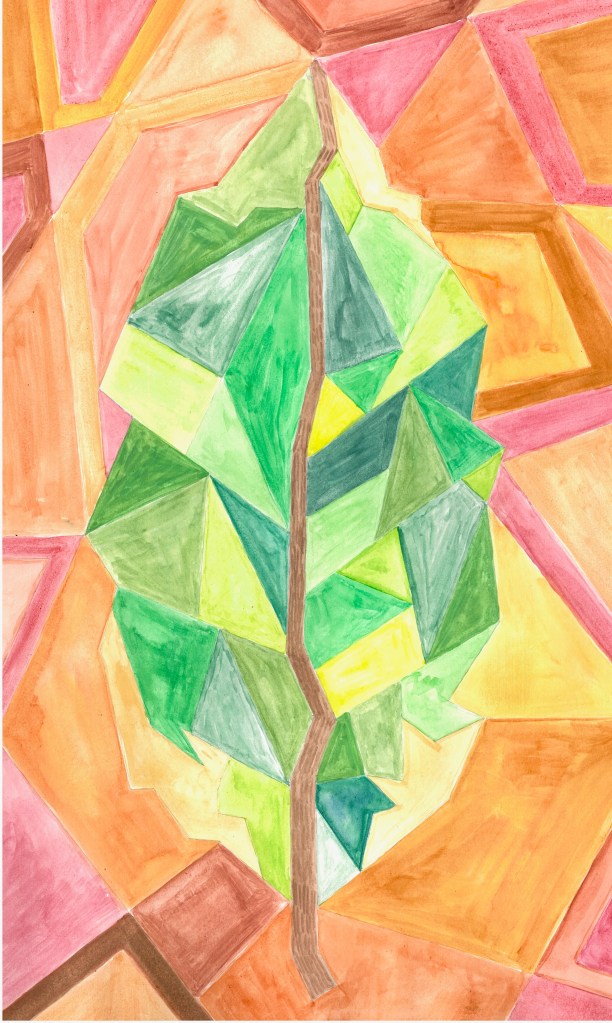
Elsewhere, you will encounter a carefully rendered leaf, broken down into geometric planes of green and yellow, each shaded to retain a sense of depth. The surrounding muted geometries—earthy browns and warm oranges—create a mosaic-like quality, as if we are observing a reconfigured landscape where nature’s forms have transformed into faceted jewels. This piece carries a quiet, contemplative energy, as if deconstructing nature has revealed a deeper truth—the geometry that underlies all living forms and their connections.
Wright’s idea of architecture as an organic, living process resonates deeply in these works. The students have not merely copied nature; they have engaged in a process of deconstruction and reimagination. By observing natural forms—a leaf, a flower, a mineral—the students began by breaking them down into their most essential geometric components. This abstraction does not obscure the subject but instead illuminates the complexity and structure that is often overlooked.
These compositions, with their vibrant colors and geometric precision, offer a duality—forms that are familiar but have been transformed by abstraction. The sharp lines, angularity, and carefully considered color choices, though seemingly rigid, reflect the fluidity inherent in nature itself. Each artwork challenges the viewer to reflect on how nature can be both chaotic and orderly, soft and sharp, familiar and new, all at the same time.
We encourage you to spend time with each piece, allowing the forms, colors, and compositions to reveal their deeper significance. In merging the organic with the abstract, these works invite a reflection not only on nature’s forms, but also on how we interpret and interact with them. The relationship between nature and geometry in this exhibition is not only visual—it is a philosophical contemplation on the worlds we inhabit.
We hope you enjoy this exploration of organic abstraction, where our students have successfully bridged the gap between two seemingly contrasting realms, presenting a unified and thought-provoking vision of nature and geometry.
 MMI Art Expanded Classroom
Leave a comment