
Grade 4 Elementary School Project, November 2025
Color is a tricky companion. It shifts, deceives, glows, and hides, depending on what sits beside it. No one understood this better than Josef Albers, one of the great teachers of the twentieth century.
Albers spent decades exploring how colors speak to one another, how one hue can appear brighter, duller, warmer, or cooler simply by changing its neighbour. His paintings in the Homage to the Square series were laboratories of perception, quiet geometric studies that taught generations of artists to see more deeply.
His book Interaction of Color became a cornerstone of modern color theory. It reminds us that color is not fixed or stable. It is relational. It changes in context. And we change with it.

This Grade 4 project begins right there, at that threshold of discovery.
Students studied Albers’ work and stepped into his methods, cutting and layering paper squares to test how one color behaves when placed inside another. What appears simple is actually a rich act of perception: students were learning to see like artists, noticing the delicate shifts that occur when warm sits against cool, when bright buzzes beside muted, when complementary colors spark.
From these individual explorations emerged something remarkable: a vast wall of color, built from hundreds of student-made compositions. Each square began as a quiet conversation between three or four colors. Together, they have become a chorus, an expansive, buzzing and popping grid that transforms the hallway into an artwork of its own.

Scale changes everything.
A single Albers study invites intimate viewing; a wall of Albers-inspired studies becomes a field of rhythm and variation. The students’ work highlights how repetition does not flatten difference, it amplifies it.

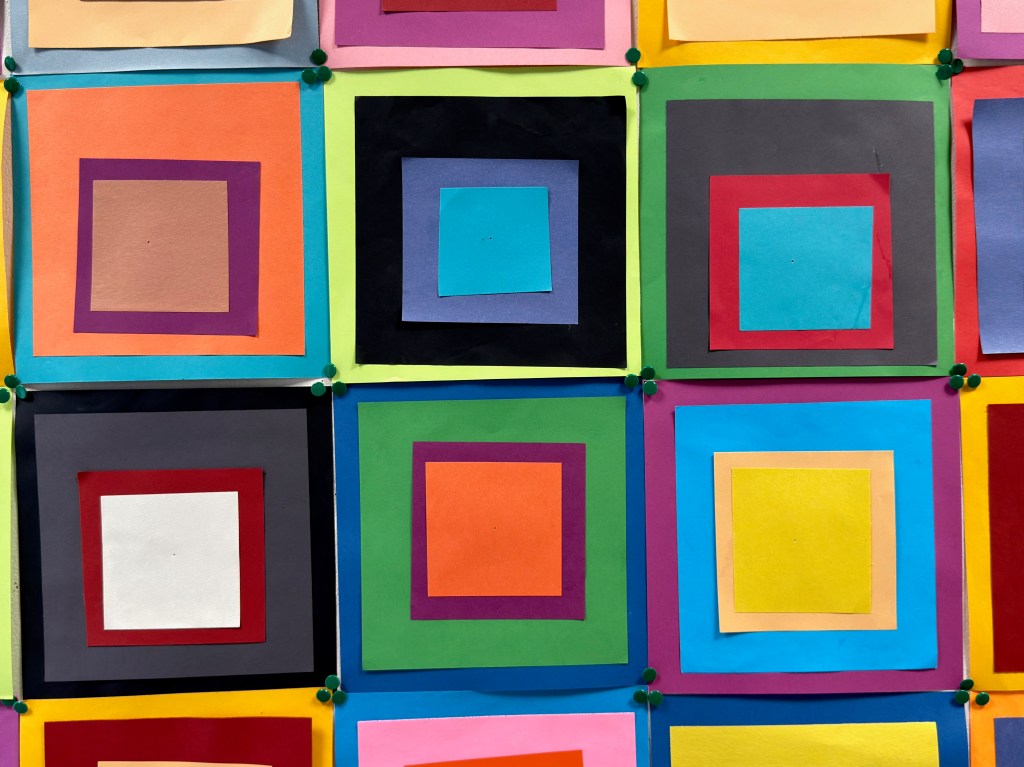
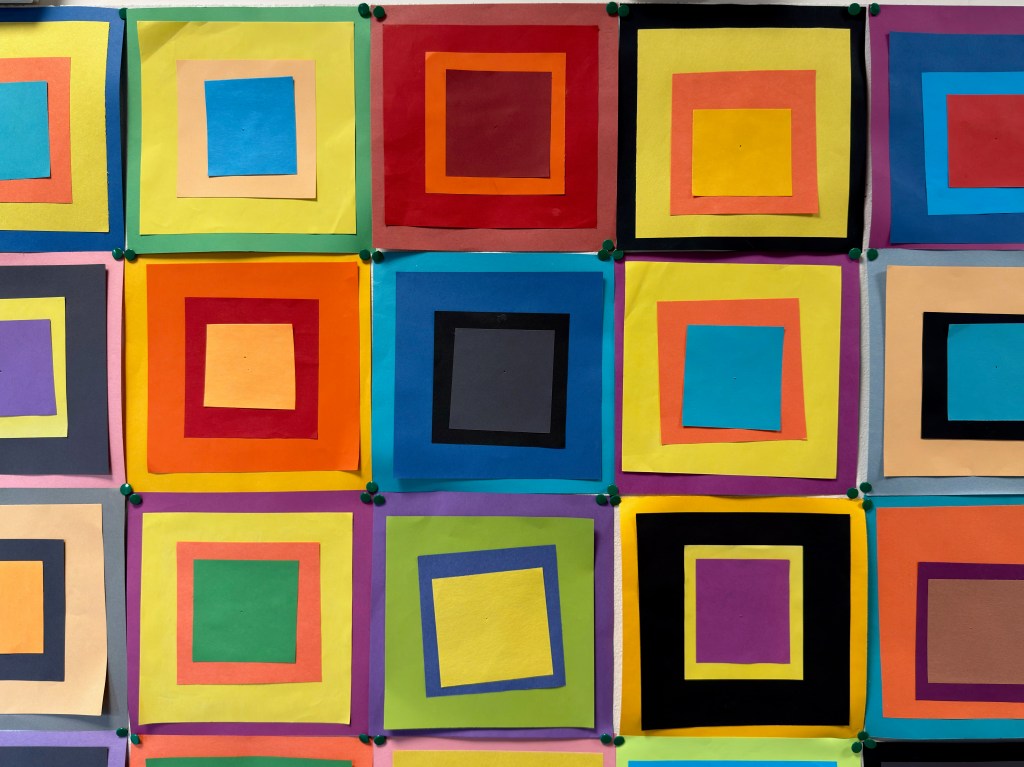
Each small composition offers its own pulse, but the collective installation has a musicality, a rising and falling of intensity, a drifting warmth, a cool breeze of blues and greys. A color landscape built from many hands.
Along the way, students practiced essential Studio Habits of Mind:
They observed closely as colors shifted under their fingertips.
They stretched and explored, testing combinations that felt unfamiliar or surprising.
They persisted, refining arrangements until the composition clicked.
They reflected, discussing what they saw and how their choices changed the mood of their work.
This project is not only a beautiful installation. It acts as a foundation. These students now carry with them a deeper understanding of how artists use color to create meaning, tension, harmony, the peculiar music of visual consciousness.
As they move into middle school and beyond, this early encounter with Albers’ ideas will stay with them, quietly shaping their drawing, painting, design, and how they respond to images in the world. It expands their vocabulary.
A wall of squares, yes. But also a wall of beginnings. A place where students learned that seeing is an art, and color is kinship and contrast.
 MMI Art Expanded Classroom
Leave a comment